
Safety First
Smoke and carbon monoxide detectors are life-safety devices, so correct placement matters. Don’t remove, relocate, or reduce existing detector coverage simply because an alarm is inconvenient or prone to nuisance alarms.
Follow the manufacturer’s placement instructions and your local building/fire-code requirements, especially for detector locations near bedrooms, kitchens, bathrooms, garages, and fuel-burning appliances.
If you’re installing a hardwired detector, turn off power at the breaker and verify the wiring is de-energized before making any electrical connections.
Time
15-30 Minutes
Difficulty
Easy
Cost
$20-$60
🧰 Tools & Materials
Tools
- Tape measure
- Pencil
- Stepladder
- Screwdriver
- Drill and appropriate drill bit, if mounting a new detector
- Stud finder, if needed
Materials
- Smoke detectors
- Carbon monoxide detectors
- Combination smoke/CO detectors, if preferred
- Batteries, if required
- Mounting screws and anchors
Before You Buy
Know Which Detectors You Need
Smoke detectors and carbon monoxide detectors protect against different hazards, so don’t assume one automatically does the job of both.
A smoke detector detects signs of a fire.
A carbon monoxide detector detects dangerous levels of carbon monoxide, an invisible and odorless gas produced by fuel-burning equipment and other combustion sources.
Combination smoke/CO alarms can provide both types of protection in one unit when they’re approved for both purposes.
Before buying detectors, consider:
- Number of bedrooms
- Number of levels in the home
- Basement
- Attached garage
- Fuel-burning appliances
- Existing hardwired or interconnected alarms
- Detector locations already installed
💡 Pro Tip: Walk through the entire house before buying anything. Count the locations that need protection rather than simply replacing the number of detectors you currently have.
Before You Start
Detector-placement requirements can vary by detector, home, and local code.
Always check:
- Manufacturer’s installation instructions
- Current local requirements
- Existing hardwired alarm locations
Don’t move an existing detector simply because another location seems more convenient.
For hardwired systems, changing detector locations may require new electrical wiring and should be handled appropriately.
Where to Install Smoke Detectors
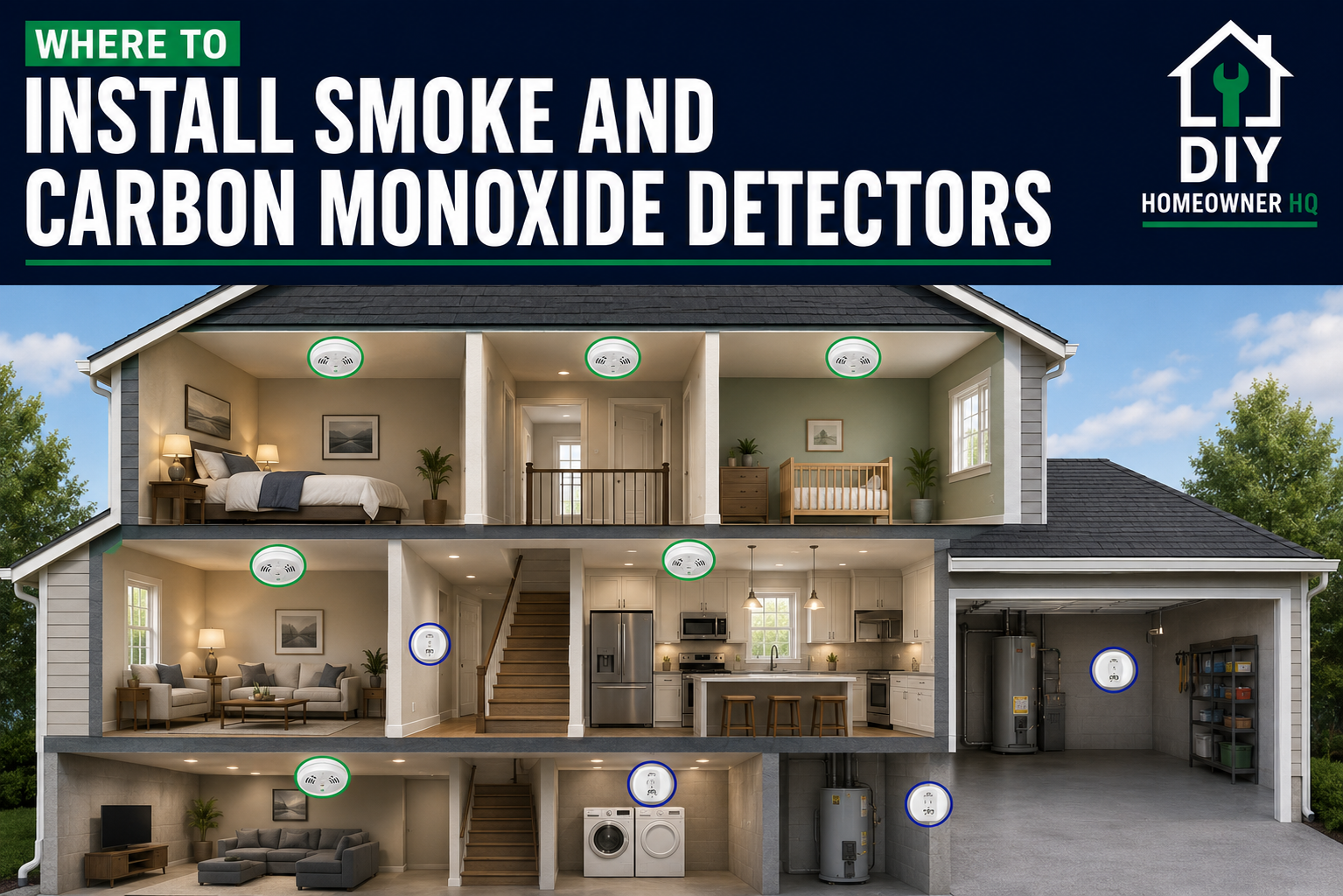
Smoke alarms should generally provide protection throughout the home’s sleeping areas and levels.
Common locations include:
- Inside each bedroom
- Outside each separate sleeping area
- On every level of the home
- In the basement
For a home with several bedrooms along one hallway, that often means a detector inside each bedroom plus another detector in the hallway outside them.
What You Should See: Sleeping areas should have nearby smoke-alarm coverage without relying on a detector located on another floor or distant part of the house.
💡 Pro Tip: Don’t forget finished basements. If people spend time downstairs—or especially if there’s a basement bedroom—the basement needs appropriate alarm coverage too.
Where to Install Carbon Monoxide Detectors
Carbon monoxide alarms are especially important in homes with fuel-burning appliances, fireplaces, or attached garages.
Placement requirements vary, but common recommendations include installing CO alarms:
- Outside sleeping areas
- On each level of the home
- In other locations specified by the manufacturer or local requirements
The goal is to provide warning before carbon monoxide reaches people while they’re sleeping.
What You Should See: Bedrooms should have appropriate CO protection nearby, and each occupied level should have coverage as required.
If Yours Looks Different: If your home is all-electric and has no attached garage or other obvious combustion source, don’t automatically assume CO protection isn’t needed. Check your local requirements and consider other potential sources of carbon monoxide.
Smoke Detector Placement in Bedrooms
Install a smoke detector inside each bedroom where required.
For ceiling-mounted detectors, follow the manufacturer’s instructions for clearance from walls and corners.
If mounting on a wall is permitted, follow the manufacturer’s specified distance below the ceiling.
Avoid guessing at these measurements because placement requirements can differ by alarm and jurisdiction.
Problem: There’s a ceiling fan in the middle of the room.
Don’t automatically mount the detector directly beside the fan. Air movement can affect how smoke reaches an alarm. Follow the manufacturer’s required separation from ceiling fans and air vents.
Smoke Detector Placement Outside Bedrooms
Install smoke-alarm protection outside sleeping areas.
In many homes, this means a hallway connecting several bedrooms.
Position the alarm where it can effectively serve the sleeping area while still meeting the manufacturer’s spacing requirements.
What You Should See: Someone sleeping behind a closed bedroom door should have smoke-alarm protection both inside the bedroom and nearby outside the sleeping area where required.
Where to Put Detectors on Different Floors
Each level of the home should have appropriate alarm coverage.
That includes areas homeowners sometimes overlook, such as:
- Basements
- Finished attics used as living space
- Split levels
- Upstairs hallways
For smoke alarms near stairways, follow applicable placement requirements and manufacturer instructions.
💡 Pro Tip: Think of the house vertically, not just room by room. A detector upstairs doesn’t replace the need for appropriate protection downstairs.
Where to Put Detectors in a Basement
Install required smoke and carbon monoxide protection in the basement according to the manufacturer’s instructions and local requirements.
If the basement contains a furnace, boiler, water heater, fireplace, or other fuel-burning equipment, proper CO protection becomes particularly important.
Don’t place a CO detector directly beside a fuel-burning appliance unless the manufacturer specifically allows that location.
If Yours Looks Different: A finished basement with bedrooms may require additional alarms beyond the detector serving the general basement area.
Where Not to Install Smoke Detectors
Avoid locations that can cause nuisance alarms or interfere with smoke reaching the detector.
Depending on the manufacturer’s instructions, problematic locations may include areas:
- Too close to cooking appliances
- Immediately outside steamy bathrooms
- Near HVAC supply or return vents
- Directly beside ceiling fans
- In unusually dusty areas
- In dead-air spaces near certain wall/ceiling intersections
Don’t simply move a detector farther away every time cooking triggers it. Check the manufacturer’s placement recommendations first.
Problem: The detector goes off every time you cook.
The detector may be too close to the cooking area, but don’t disable it. Verify whether its location meets current placement guidance and consider an appropriate detector type or approved relocation if necessary.
Where Not to Install Carbon Monoxide Detectors
Carbon monoxide detectors also need thoughtful placement.
Avoid installing them:
- Where furniture or curtains block airflow
- In extremely humid locations unless approved
- Where temperatures fall outside the detector’s operating range
- Directly beside fuel-burning appliances unless instructed
- In locations specifically prohibited by the manufacturer
Don’t assume carbon monoxide always stays near the floor or always rises to the ceiling. Install the detector at the height and location specified by its manufacturer.
💡 Pro Tip: This is especially important with plug-in CO detectors. Don’t move one to a poorly positioned outlet simply because it’s easier to reach.
What About the Garage?
An attached garage can be a source of carbon monoxide, but that doesn’t necessarily mean the detector itself belongs inside the garage.
Garages can experience temperature extremes, dust, fumes, and other conditions outside a detector’s approved operating environment.
Instead, follow the manufacturer’s instructions and local requirements for protecting the living space adjacent to an attached garage.
Never run a vehicle in an attached garage—even with the garage door open.
Combination Smoke and CO Detectors
Combination detectors can simplify installation because one device provides both smoke and carbon monoxide detection.
They’re especially useful in locations where both types of protection are required.
However, the location still needs to satisfy the placement requirements for both functions.
Don’t choose a poor smoke-detector location simply because it’s convenient for CO detection, or vice versa.
Check Existing Detectors
Once you’ve mapped out where detectors should be located, inspect the alarms already in your home.
Check:
- Detector type
- Location
- Manufacture date
- Replacement date
- Battery condition
- Power source
- Interconnection
- TEST button operation
A detector can be installed in the right locations and still fail to provide reliable protection if it’s expired or doesn’t work. If an alarm has reached the end of its service life, follow our guide on How to Replace a Smoke Detector.
If an alarm is making an occasional chirping sound rather than sounding continuously, use our guide on How to Stop a Smoke Detector From Chirping to troubleshoot the cause.
What You Should See: Every required location should have an appropriate detector that is powered, within its service life, and able to pass its TEST-button check.
Test Everything When You’re Finished
Press the TEST button on every detector according to the manufacturer’s instructions.
For a complete walkthrough, see How to Test a Smoke and Carbon Monoxide Detector.
For interconnected systems, confirm that the other alarms respond as designed.
If you added new detectors, record their installation or replacement dates somewhere easy to find.
🛑 Common Mistakes to Avoid
- Installing only one smoke detector for the entire house
- Forgetting detectors inside bedrooms
- Forgetting basement coverage
- Assuming smoke detectors also detect carbon monoxide
- Placing alarms too close to cooking appliances
- Installing detectors beside HVAC vents or ceiling fans without checking required clearances
- Putting a CO detector directly beside a fuel-burning appliance
- Assuming carbon monoxide detectors must always be mounted near the floor
- Installing detectors in a garage when they aren’t approved for that environment
- Ignoring manufacturer placement instructions
- Leaving expired detectors installed because they still appear to work
- Forgetting to test detectors after installation
❓ FAQs
Do I need a smoke detector in every bedroom?
Current residential requirements commonly call for smoke alarms inside sleeping rooms, outside sleeping areas, and on each level of the home. Requirements can vary, so check your local rules.
Do I need a carbon monoxide detector in every bedroom?
Not necessarily. CO alarms are commonly required outside sleeping areas and on levels of the home, but exact placement depends on local requirements and manufacturer instructions.
Should a carbon monoxide detector be high or low?
Follow the manufacturer’s mounting instructions for your specific detector. Don’t rely on the common misconception that every CO detector must be installed close to the floor.
Can I put a smoke detector in the kitchen?
Placement near cooking equipment requires care because normal cooking can cause nuisance alarms. Follow the manufacturer’s minimum-distance and placement guidance rather than positioning one directly beside the stove.
Should I put a carbon monoxide detector next to my furnace?
Usually not directly beside it unless the manufacturer specifically recommends that location. You want appropriate CO coverage without placing the detector where normal appliance operation or environmental conditions interfere with it.
Do I need detectors in the basement?
Smoke-alarm coverage is generally needed on every level, including basements. CO requirements depend on the home and applicable rules, but basement fuel-burning equipment can make CO protection especially important.
Can I use combination smoke and carbon monoxide detectors everywhere?
Combination detectors can work well where both types of protection are needed, provided the location meets the manufacturer’s requirements for both smoke and CO detection.
📞 When to Call a Professional
Call a licensed electrician or qualified professional if:
- You need to add new hardwired detector locations
- Existing hardwired detectors have no power
- You’re unsure whether interconnected alarms are compatible
- Wiring is damaged or unfamiliar
- You’re remodeling and need to determine current alarm requirements
- You’re unsure whether the existing detector layout provides appropriate coverage
For questions about exactly how many alarms your home requires or where local code requires them, check with your local building or fire authority.
If a smoke or carbon monoxide detector sounds during normal operation, don’t assume it’s a placement problem or malfunction. Treat the alarm as a potential emergency and follow the appropriate safety procedures.
Related DIY Guides
How to Replace a Smoke Detector
How to Replace a Carbon Monoxide Detector
How to Test a Smoke and Carbon Monoxide Detector