
Safety First
A breaker that keeps tripping is warning you that something is wrong. Don’t repeatedly reset it or try to force it to stay on. You can safely unplug devices, reduce the load, and operate the breaker handle, but never remove the electrical panel cover or touch wiring inside the panel for troubleshooting. If the breaker trips immediately, smells burnt, feels unusually hot, buzzes, sparks, or won’t stay on, leave it OFF and call a licensed electrician.
Time
15-30 Minutes
Difficulty
Easy
Cost
$0-$25
🔎 Common Reasons a Circuit Breaker Keeps Tripping
A circuit breaker trips when it detects an electrical condition that could be unsafe. The breaker is doing its job by shutting off power before the circuit overheats or becomes a greater hazard.
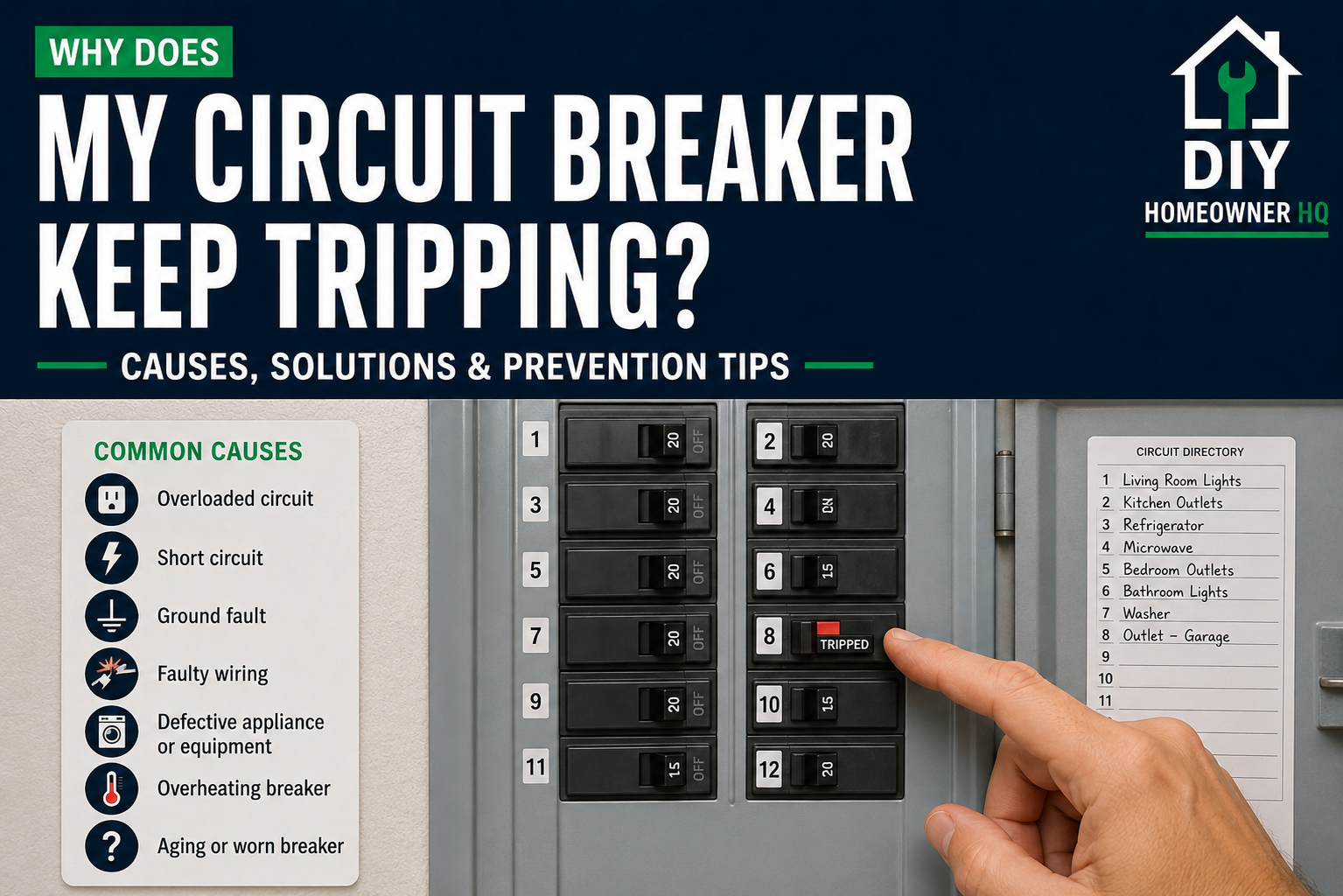
The most common causes are:
- An overloaded circuit
- A short circuit
- A ground fault
- A faulty appliance or device
- Damaged wiring
- A loose electrical connection
- A failing or worn circuit breaker
The way and timing of the trip can provide useful clues about what’s causing it.
📝 Before You Start
Think about exactly what was happening when the breaker tripped.
Ask yourself:
- Did you just plug something in?
- Did you turn on a particular appliance?
- Were several high-wattage devices running at once?
- Does the breaker trip immediately or after several minutes?
- Does it happen only when one specific device is used?
- Has this circuit recently started tripping after years without problems?
Unplug portable appliances and devices from the affected circuit before resetting the breaker.
If you’re unsure which breaker controls the affected area, see How to Find Which Breaker Controls an Outlet or Light.
Step 1: Reset the Breaker Once
Move the tripped breaker completely to the OFF position and then firmly back to ON.
Don’t repeatedly flip the breaker if it trips again.
For the complete resetting procedure, see How to Reset a Tripped Circuit Breaker.
What You Should See: The breaker should remain firmly in the ON position and power should return to the circuit.
If Yours Looks Different: If the breaker immediately trips again with the circuit’s devices unplugged, leave it OFF and call a licensed electrician.
Step 2: Check for an Overloaded Circuit
An overloaded circuit is one of the most common reasons a breaker trips.
Think about what was operating immediately before the trip.
High-wattage devices such as these can place significant demand on a circuit:
- Space heaters
- Hair dryers
- Toasters
- Microwaves
- Portable air conditioners
- Vacuum cleaners
- Irons
- Power tools
If several high-draw devices were running simultaneously, unplug some of them.
Reset the breaker once and see whether it remains on with the electrical load reduced.
What You Should See: If an overload caused the trip, the breaker may remain ON after some of the load has been removed.
If Yours Looks Different: If the breaker trips with little or nothing connected to the circuit, an overload is less likely to be the only problem.
💡 Pro Tip: Moving an appliance to another outlet doesn’t necessarily move it to another circuit. Multiple outlets—even in different rooms—can be supplied by the same breaker.
Step 3: Check for a Problem With an Appliance
If the breaker trips whenever one particular appliance or device is used, unplug that device.
Reset the breaker and leave the suspected appliance disconnected.
If everything else operates normally, the appliance, its cord, or its plug may be causing the trip.
What You Should See: The circuit should operate normally with the suspected device unplugged.
If Yours Looks Different: If the breaker continues tripping without that appliance connected, continue troubleshooting rather than assuming you’ve found the cause.
Step 4: Look for Signs of a Short Circuit
A short circuit can cause a breaker to trip very quickly—sometimes immediately after the breaker is reset or a particular device is turned on.
Possible warning signs include:
- An immediate breaker trip
- A burning smell
- Scorch marks around an outlet or switch
- A damaged electrical cord
- Sparking
- Popping sounds
Do not remove outlets, switches, or the electrical panel cover simply to search for the short unless you’re qualified and prepared to safely troubleshoot electrical wiring.
If Yours Looks Different: If the breaker trips immediately even after portable devices have been unplugged, leave the breaker OFF and have the circuit inspected.
Step 5: Consider a Ground Fault
A ground fault occurs when electrical current takes an unintended path to ground.
These problems are particularly important in areas where electricity and moisture may be present, including:
- Bathrooms
- Kitchens
- Garages
- Basements
- Laundry areas
- Exterior outlets
Some circuits are protected by GFCI receptacles or GFCI breakers.
If you’re troubleshooting receptacles in one of these areas, check whether a GFCI outlet has also tripped.
For more information, see How to Replace a GFCI Outlet.
Step 6: Pay Attention to When the Breaker Trips
The timing of the trip can help narrow down the cause.
If it trips immediately:
A short circuit, ground fault, faulty device, wiring problem, or other serious fault may be present.
If it trips after several minutes:
The circuit may be overloaded, or a device may be drawing excessive current as it operates.
If it trips only when one appliance starts:
The appliance itself or the circuit’s total load may be the problem.
If it trips randomly:
A loose connection, intermittent equipment problem, wiring fault, or failing breaker may require professional diagnosis.
Don’t treat these patterns as definitive diagnoses—they’re clues that can help determine the next step.
Step 7: Check for Visible Warning Signs
Without removing any electrical covers, look around the affected outlets, switches, cords, and appliances.
Watch for:
- Discoloration
- Melted plastic
- Damaged cords
- Loose plugs
- Cracked receptacles
- Burning smells
- Buzzing or crackling sounds
If you find any of these warning signs, stop using the affected device or circuit until the problem is corrected.
Step 8: Determine Whether the Breaker Itself May Be the Problem
Circuit breakers can wear out or fail, although you shouldn’t assume the breaker is bad simply because it trips.
A breaker may need professional evaluation if:
- It trips with little or no load
- It won’t remain ON
- Its handle feels unusually loose
- It feels unusually hot
- There are signs of physical damage
- The circuit has been checked and no other cause has been found
Replacing a breaker doesn’t fix an overload, short circuit, ground fault, or damaged wiring.
If the breaker itself is determined to be defective, see How to Replace a Circuit Breaker for an overview of what’s involved. Working inside an electrical panel exposes you to significantly greater electrical hazards than operating the breaker handles.
🔎 Troubleshooting / Common Problems
Problem: The breaker trips when several appliances are running.
Solution: The circuit may be overloaded. Reduce the number of high-wattage devices operating on that circuit at the same time.
Problem: The breaker trips whenever one particular appliance is turned on.
Solution: Stop using that appliance and test the circuit without it. The appliance, cord, or plug may have a fault.
Problem: The breaker trips immediately after being reset.
Solution: Leave it OFF. An immediate trip can indicate a short circuit, ground fault, wiring problem, or faulty equipment that needs further diagnosis.
Problem: The breaker trips after running for several minutes.
Solution: Look for excessive electrical load or equipment that draws substantial current while operating. If the cause isn’t obvious, have the circuit inspected.
Problem: The breaker keeps tripping even when everything is unplugged.
Solution: Stop resetting it. A wiring fault, hardwired equipment problem, or defective breaker may be present and should be evaluated by a licensed electrician.
❌ Common Mistakes to Avoid
- Repeatedly resetting a breaker that keeps tripping
- Assuming the breaker itself is automatically defective
- Replacing a breaker with a higher-amperage breaker
- Moving an appliance to another outlet without confirming it’s on another circuit
- Ignoring burning smells, heat, buzzing, or discoloration
- Continuing to use an appliance that consistently trips the breaker
- Removing the electrical panel cover for basic troubleshooting
- Trying to bypass the breaker or prevent it from tripping
Never install a higher-amperage breaker simply to stop nuisance trips. Breaker size must be appropriate for the circuit conductors and equipment it protects.
💡 Pro Tips
💡 Pro Tip: Keep track of exactly what was running each time the breaker trips. A pattern may quickly reveal an overloaded circuit or problematic appliance.
💡 Pro Tip: If you’re unsure what the breaker supplies, properly identifying and labeling the circuit can make troubleshooting much easier. See How to Label an Electrical Panel for a systematic approach.
❓ FAQs
Why does my breaker keep tripping with nothing plugged in?
The circuit may still supply hardwired lights or equipment, or there may be a wiring fault, ground fault, short circuit, or defective breaker. If you’ve removed the obvious loads and it continues tripping, leave it OFF and have it inspected.
Can a bad appliance trip a circuit breaker?
Yes. A faulty appliance, damaged cord, internal short, or other electrical problem within a device can cause the breaker protecting the circuit to trip.
Can too many things plugged in cause a breaker to trip?
Yes. If the combined electrical demand exceeds what the circuit is designed to carry, the breaker can trip to protect the wiring from overheating.
Why does my breaker trip only after a few minutes?
An overload or equipment problem may not cause an immediate trip. The breaker can trip after excessive current has been flowing for a period of time.
Does a breaker that keeps tripping need to be replaced?
Not necessarily. Frequent tripping often means the breaker is responding to a problem elsewhere on the circuit. The cause should be identified before assuming the breaker itself is defective.
Can I just replace a 15-amp breaker with a 20-amp breaker?
No. Never increase breaker amperage simply to stop tripping. The breaker must be correctly sized for the circuit wiring and other requirements. An improperly oversized breaker can allow wiring to overheat without adequate protection.
📞 When to Call a Professional
Call a licensed electrician if:
- The breaker immediately trips after being reset
- It trips with little or no load connected
- You smell burning
- You see scorch marks or melted components
- The breaker or panel feels unusually hot
- You hear buzzing, crackling, or popping
- You see sparks
- The breaker is physically damaged
- Water or corrosion is present around the panel
- You suspect damaged or loose wiring
- The breaker continues tripping and you cannot identify the cause
- Troubleshooting would require removing the electrical panel cover
A breaker that repeatedly trips is providing important information. The goal isn’t simply to make it stay ON—the goal is to determine why it’s tripping and correct the underlying problem.
🔗 Related DIY Guides
How to Reset a Tripped Circuit Breaker
How to Find Which Breaker Controls an Outlet or Light
How to Label an Electrical Panel