
Safety First
Finding which breaker controls an outlet or light should only require operating the breaker handles and testing whether power turns off. Never remove the electrical panel cover or touch wiring or components inside the panel. Keep your hands dry and stand on a dry surface. If you notice buzzing, burning smells, sparks, unusual heat, damaged breakers, or anything else concerning at the panel, stop and call a licensed electrician.
Time
30-60 Minutes
Difficulty
Easy
Cost
$0-$20
🔧 Tools
- Small lamp, phone charger, or other plug-in device
- Flashlight or phone flashlight
- Notepad or phone for taking notes
- Optional: plug-in outlet tester
- Optional: second person to help
📦 Materials
No materials are normally required.
If you plan to update your electrical panel while identifying circuits, have a pen or permanent marker available for the circuit directory.
📝 Before You Start
Decide exactly which outlet or light you need to identify.
For an outlet, plug in a lamp or another device that makes it obvious when power has been disconnected.
For a light fixture, turn the light ON before going to the electrical panel.
If possible, have another person stay near the outlet or light while you operate the breakers. They can tell you immediately when the power shuts off.
Before switching breakers, consider anything else that could lose power, including computers, refrigerators, freezers, security equipment, and other sensitive devices.
💡 Pro Tip: Take a photo of the existing panel directory before you begin. Even if the labels aren’t completely accurate, they may help narrow down which breaker to test first.
Step 1: Check the Existing Panel Labels
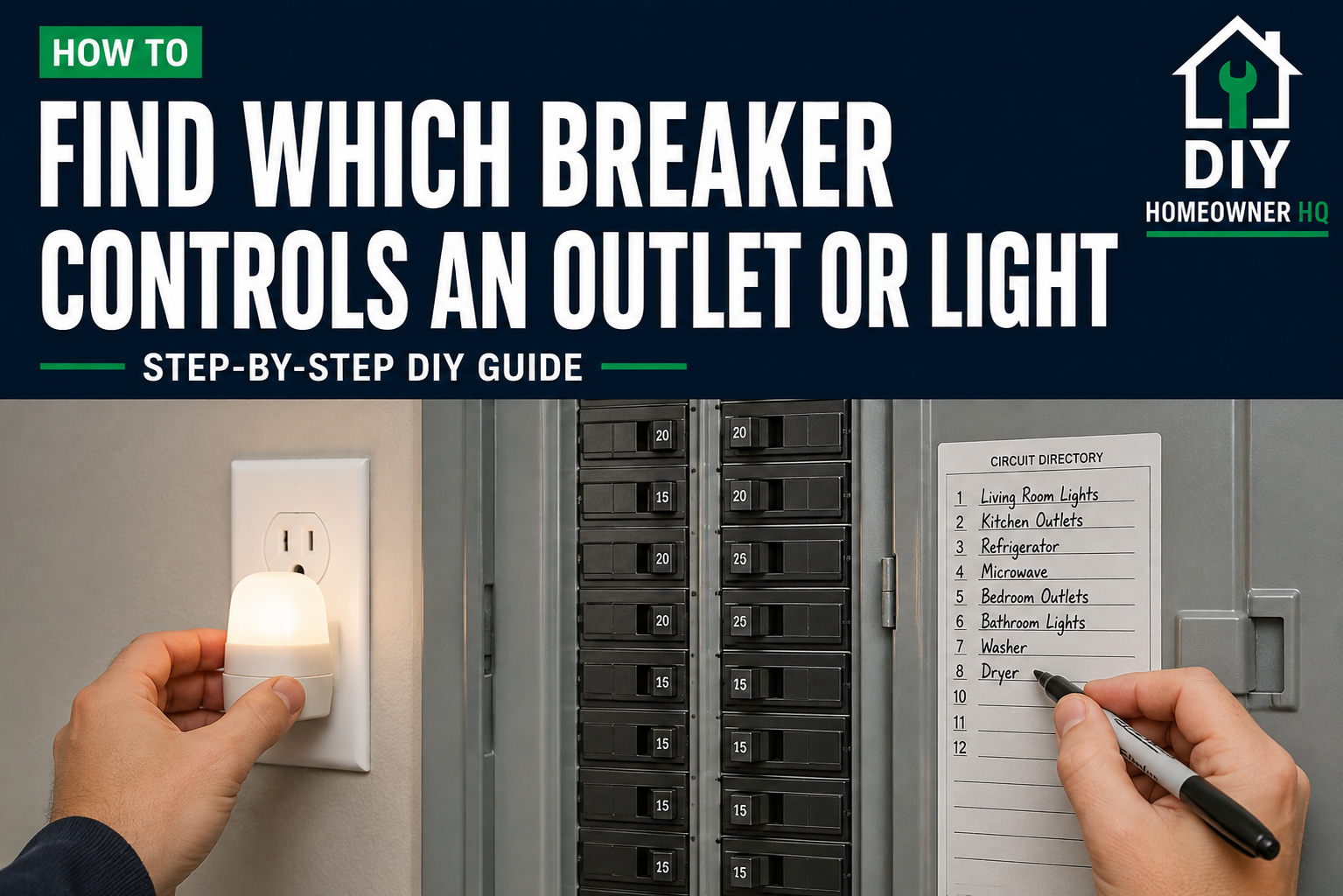
Open the electrical panel door and look at the circuit directory.
Do not remove the metal panel cover.
Look for a label that corresponds with the room or area containing the outlet or light you’re trying to identify.
For example, an outlet in a bedroom may be controlled by a breaker labeled “Bedroom,” “Bedroom Outlets,” or something similar.
What You Should See: A list of circuit descriptions corresponding with the breaker positions.
If Yours Looks Different: If the panel is unlabeled or the existing labels appear unreliable, you’ll need to identify the circuit by testing breakers one at a time.
Step 2: Turn On the Light or Plug In a Test Device
For a light, turn the wall switch ON so the fixture is illuminated.
For an outlet, plug in a lamp, phone charger, radio, or outlet tester.
Choose something that makes it easy to tell when power disappears.
What You Should See: The light or plugged-in device should be operating normally before you begin testing breakers.
If Yours Looks Different: If the outlet or light doesn’t currently have power, you won’t be able to identify its breaker using this method. If you’re dealing with a dead receptacle, see How to Fix an Outlet That Isn’t Working first.
Step 3: Test the Most Likely Breaker
At the electrical panel, start with the breaker most likely to control the outlet or light based on the existing directory.
Move only that breaker to the OFF position.
If you have a helper, have them tell you whether the light or test device turned off.
If you’re working alone, return to the room and check it yourself.
What You Should See: If you’ve found the correct breaker, the light or plugged-in device should lose power.
If Yours Looks Different: If it still has power, return that breaker to ON before testing another one.
Step 4: Work Through the Breakers One at a Time
If the first breaker wasn’t correct, continue testing likely breakers individually.
Switch one breaker OFF, check the outlet or light, and then return that breaker to ON before testing the next one.
Avoid shutting off several breakers at once. Doing so makes it difficult to determine which breaker actually controls the circuit.
💡 Pro Tip: If your panel is poorly labeled, start recording what each breaker controls as you test them. You can gradually turn the process into a complete panel directory instead of having to repeat the work later.
Step 5: Confirm You’ve Found the Correct Breaker
Once the outlet or light loses power, leave that breaker OFF temporarily.
Return to the outlet or fixture and verify that it no longer operates.
For an outlet, check your lamp or plug-in tester.
For a light, try the wall switch.
What You Should See: The outlet or light should remain completely without power while the identified breaker is OFF.
Step 6: Label the Circuit
Write down the breaker number and what it controls.
Use a specific description whenever possible.
Instead of:
“Bedroom”
Use:
“Primary Bedroom Outlets”
or:
“Upstairs Bedroom Lights”
Specific labels will make future electrical work much easier.
If your panel has several missing or inaccurate labels, see How to Label an Electrical Panel to map the rest of the circuits systematically.
Step 7: Leave the Breaker Off or Restore Power
If you’re identifying the breaker because you’re about to work on the outlet, switch, or fixture, leave the breaker OFF.
Before beginning electrical work, verify that power is actually off at the device with an appropriate voltage tester. Do not rely solely on the panel label.
If you were only identifying the circuit, move the breaker back to ON and confirm that power returns.
What You Should See: With the breaker ON, the outlet or light should operate normally again.
If Yours Looks Different: If the breaker trips or will not remain ON, don’t repeatedly reset it. See How to Reset a Tripped Circuit Breaker for basic troubleshooting.
🔎 Troubleshooting / Common Problems
Problem: None of the breakers seem to turn off the outlet.
Solution: Make sure you’re checking the correct electrical panel. Some homes have subpanels or more than one panel. Also confirm that your test device is actually plugged into the outlet you’re trying to identify.
Problem: The light turns off but some outlets in the same room stay on.
Solution: That’s entirely possible. A single room can be supplied by multiple circuits, and lighting may be on a different circuit from the receptacles.
Problem: One breaker shuts off outlets in several rooms.
Solution: This can be normal, particularly in older homes. Record all of the areas you identify so the panel label accurately describes the circuit.
Problem: A breaker trips when you turn it back on.
Solution: Leave it OFF if it immediately trips again. Repeated tripping can indicate an overload, short circuit, ground fault, appliance problem, or another electrical issue.
❌ Common Mistakes to Avoid
- Removing the electrical panel cover
- Assuming the existing panel labels are correct
- Turning several breakers off simultaneously
- Forgetting to turn tested breakers back ON
- Assuming every outlet and light in one room shares the same circuit
- Using vague circuit labels
- Relying only on the panel directory before performing electrical work
- Repeatedly resetting a breaker that continues to trip
💡 Pro Tips
💡 Pro Tip: A second person can dramatically speed up this job. One person can operate the breakers while the other watches the light or test device.
💡 Pro Tip: If you’re identifying a circuit before replacing an outlet, switch, or light fixture, use the breaker identification only as the first step. Always verify that the device itself is de-energized before touching any wiring.
❓ FAQs
Can I find a breaker without a circuit breaker finder?
Yes. Turning breakers off one at a time while monitoring the outlet or light works well and requires no specialized equipment.
Is there a tool that finds which breaker controls an outlet?
Yes. A circuit breaker finder uses a transmitter at the outlet and a receiver at the electrical panel to help identify the corresponding breaker. It can be particularly useful when working alone or mapping many circuits.
Can outlets in the same room be on different breakers?
Yes. Never assume every receptacle or light in a room is supplied by the same circuit.
Can a light and an outlet be on the same breaker?
Yes. A branch circuit may supply both lighting and receptacles depending on how the home is wired.
Should I trust the labels already written in my electrical panel?
Treat them as a useful starting point, but verify the circuit before doing electrical work. Panel directories can become inaccurate after renovations or electrical changes.
Do I still need a voltage tester after finding the correct breaker?
Yes, if you’re going to work on wiring or an electrical device. Identifying the breaker and switching it OFF does not replace verifying that the circuit is actually de-energized before beginning work.
📞 When to Call a Professional
Call a licensed electrician if:
- You cannot safely determine which breaker controls the circuit
- The breaker repeatedly trips
- You smell burning or notice discoloration
- The panel or a breaker feels unusually hot
- You hear buzzing, crackling, or popping
- You see sparks
- Breakers appear loose or damaged
- There is moisture or corrosion around the electrical panel
- Identifying the circuit would require removing the panel cover
- You are uncomfortable working around the electrical panel
Finding a breaker should require only operating the external breaker handles and checking whether power turns off. There is no reason to access the wiring inside the panel for this job.
🔗 Related DIY Guides
How to Label an Electrical Panel
How to Reset a Tripped Circuit Breaker
How to Replace a Circuit Breaker