
Safety First
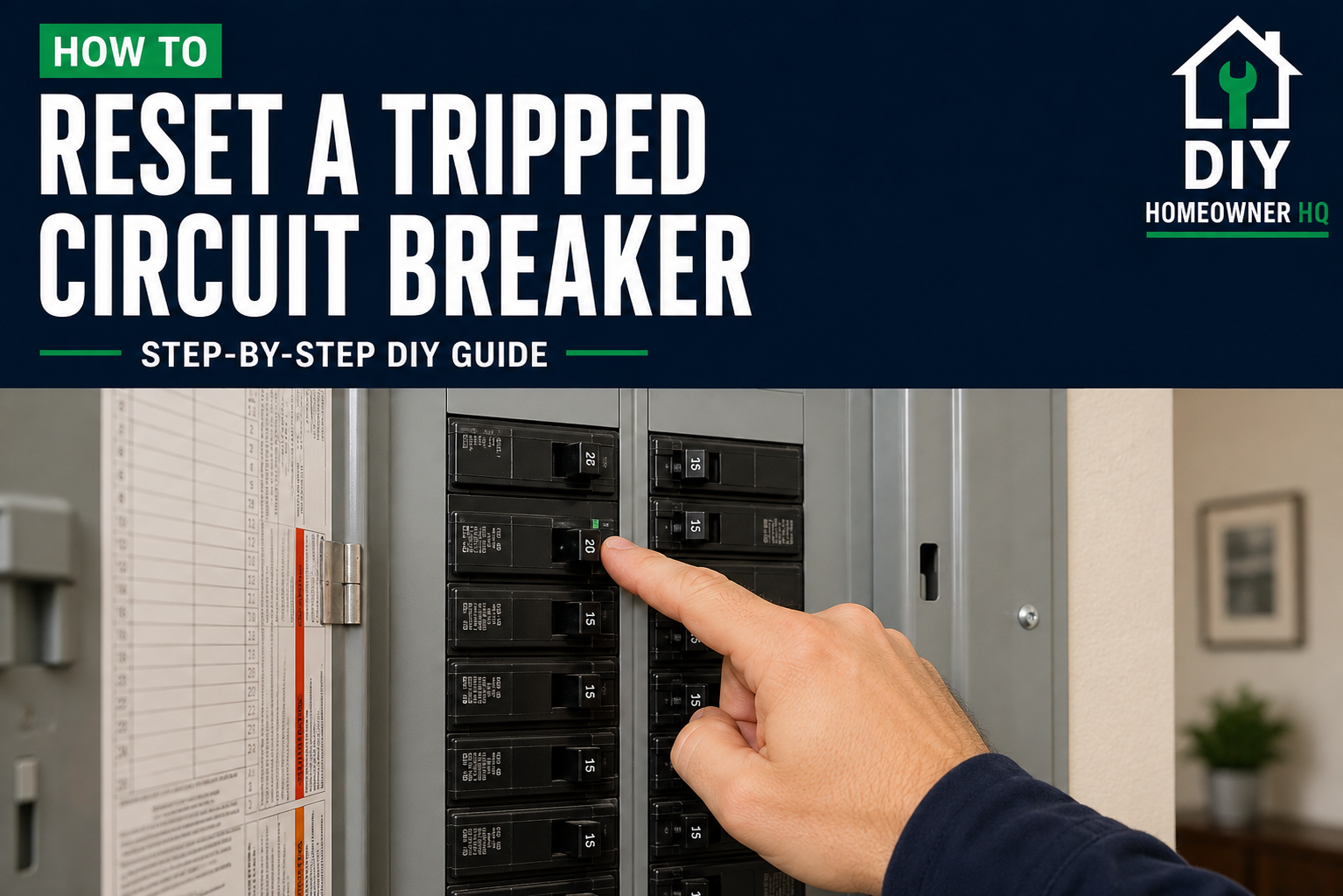
A tripped breaker is usually safe to reset, but never remove the electrical panel cover or touch any wiring inside the panel for this project. Keep your hands dry, stand on a dry surface, and operate only the breaker handle. If you notice burning smells, buzzing, visible damage, heat, sparks, or the breaker immediately trips again after resetting, leave it off and call a licensed electrician.
Time
5-10 Minutes
Difficulty
Easy
Cost
$0-$10
🔧 Tools
- Flashlight or phone flashlight
- Optional: circuit tester or plug-in outlet tester
📦 Materials
No materials are normally required.
⚠️ Signs a Circuit Breaker Has Tripped
A tripped circuit breaker may cause:
- Several outlets to suddenly stop working
- Lights in one area of the home to go out
- An appliance to lose power
- A breaker handle to sit between the ON and OFF positions
- Power to disappear after plugging in or turning on a high-draw appliance
If only one outlet has lost power, the breaker may not be the problem. Check our How to Fix an Outlet That Isn’t Working guide for other common causes.
📝 Before You Start
Turn off or unplug anything that was running on the affected circuit when the breaker tripped.
This is especially important for space heaters, hair dryers, microwaves, power tools, window air conditioners, and other high-draw appliances.
If you know what caused the overload, remove that load before resetting the breaker.
💡 Pro Tip: If your electrical panel is not clearly labeled, make a note of which rooms, outlets, or appliances lost power. That information will help you identify the correct breaker.
Step 1: Locate Your Electrical Panel
Find your home’s main electrical panel. Common locations include the garage, basement, utility room, laundry room, hallway, or exterior wall.
Open only the panel door that gives you access to the breaker handles.
Do not remove any screws or the metal panel cover.
What You Should See: Rows of circuit breakers with handles labeled ON and OFF.
If Yours Looks Different: If you have an older fuse panel rather than circuit breakers, do not follow these reset instructions.
Step 2: Find the Tripped Breaker
Look closely at the breaker handles.
A tripped breaker does not always move completely to the OFF position. Many breakers stop somewhere between ON and OFF.
Compare the handles to the breakers around them and look for one that appears slightly out of alignment.
What You Should See: One breaker may be sitting in a middle position while the others are firmly ON.
If Yours Looks Different: Some breakers have a small trip indicator or may look almost identical to breakers that are still on. Gently checking the handle position without removing the panel cover can help identify it.
Step 3: Move the Breaker Fully to OFF
Push the tripped breaker firmly into the OFF position.
This step is important. Simply pushing a tripped breaker toward ON may not reset its internal mechanism.
You may feel or hear a small click when it reaches the fully OFF position.
What You Should See: The breaker handle should now line up with the OFF position.
Step 4: Reset the Breaker to ON
Move the breaker firmly from OFF to ON.
Use one deliberate motion rather than slowly easing the handle into position.
What You Should See: The breaker should remain firmly in the ON position.
If Yours Looks Different: If the breaker will not stay ON or immediately snaps back to the tripped position, do not repeatedly reset it. Leave it OFF and investigate the cause.
Step 5: Check Whether Power Has Returned
Check the lights, outlets, or appliance that lost power.
If you are checking an outlet, plug in a small lamp or use an outlet tester.
What You Should See: Power should return to the affected part of the circuit.
If an outlet still does not work even though the breaker remains ON, follow How to Fix an Outlet That Isn’t Working to check for other causes such as a tripped GFCI.
Step 6: Reconnect Appliances One at a Time
If you unplugged appliances before resetting the breaker, reconnect them one at a time.
Wait briefly after each one.
If the breaker trips when a particular appliance is plugged in or turned on, that appliance or the total electrical load may be causing the problem.
What You Should See: The breaker should remain ON as normal loads are restored.
If Yours Looks Different: If adding one appliance repeatedly trips the breaker, stop using that appliance on the circuit until the cause is identified.
🔎 Troubleshooting / Common Problems
Problem: The breaker trips again immediately.
Solution: Leave it OFF. An immediate trip can indicate a short circuit, ground fault, damaged appliance, or another electrical problem that should be diagnosed before the breaker is reset again.
Problem: The breaker trips only when several appliances are running.
Solution: The circuit may be overloaded. Unplug or turn off some of the appliances and distribute them to other circuits when practical.
Problem: The breaker stays ON but an outlet still has no power.
Solution: Check nearby GFCI outlets. A tripped GFCI can shut off power to additional outlets farther downstream. If necessary, see How to Replace a GFCI Outlet for more information about GFCI devices.
Problem: The breaker handle feels loose or will not stay in position.
Solution: Stop using the circuit and have the breaker inspected. If replacement is ultimately necessary, see How to Replace a Circuit Breaker, but panel work carries significantly greater electrical risk than simply resetting a breaker.
❌ Common Mistakes to Avoid
- Repeatedly resetting a breaker that keeps tripping
- Trying to reset the breaker without first moving it fully to OFF
- Removing the electrical panel cover
- Touching wiring or other components inside the panel
- Ignoring burning smells, buzzing, heat, or discoloration
- Turning every breaker off because you cannot identify the tripped one
- Immediately reconnecting the same heavy electrical load that caused the trip
💡 Pro Tip: Breakers frequently trip because too much electrical load is being placed on one circuit. If a breaker repeatedly trips when several high-wattage appliances are used together, moving some of those appliances to another circuit may prevent future trips.
💡 Pro Tip: Take a photo of your electrical panel directory and save it on your phone. It can make identifying circuits much easier during future outages or repairs.
❓ FAQs
Is it safe to reset a tripped circuit breaker yourself?
Generally, yes. Resetting a breaker using only its external handle is a normal homeowner task. Do not remove the panel cover or touch wiring inside the electrical panel.
Why do I have to turn the breaker OFF before turning it back ON?
Most circuit breakers must be moved fully to the OFF position to reset their internal trip mechanism. After that, they can be switched back ON.
Why did my circuit breaker trip?
Common causes include an overloaded circuit, a short circuit, a ground fault, damaged wiring, or a faulty appliance.
Can I reset a breaker more than once?
If the cause is obvious—such as temporarily overloading the circuit—you can remove the load and reset the breaker. If it keeps tripping, do not continue resetting it. The repeated trips are warning you that a problem still exists.
Can a circuit breaker trip without looking like it is OFF?
Yes. Many breakers move only slightly and stop in a middle position when they trip.
What if the breaker is ON but I still have no power?
Check for a tripped GFCI outlet and determine whether the outage affects one device or the entire circuit. A dead outlet may have a problem unrelated to the breaker.
📞 When to Call a Professional
Call a licensed electrician if:
- The breaker trips immediately after being reset
- The breaker repeatedly trips without an obvious overload
- You smell burning or see discoloration
- The electrical panel feels unusually hot
- You hear buzzing, crackling, or popping
- You see sparks
- The breaker is physically damaged or loose
- There are signs of water or moisture inside or around the panel
- You would need to remove the panel cover to continue troubleshooting
- You are unsure why the circuit keeps losing power
A breaker is a safety device. Repeated tripping should be treated as a warning, not an inconvenience to bypass.
🔗 Related DIY Guides
How to Replace a Circuit Breaker
How to Fix an Outlet That Isn’t Working