
Safety First
Keep fingers clear of the hinge while opening and closing the door. Door hinges can pinch hard, especially when you’re working with the hinge pin partially removed. If you remove a hinge pin, support the door and avoid removing multiple pins at the same time. Wipe up any excess lubricant immediately so it doesn’t drip onto the floor or make the area slippery.
Time
10-20 Minutes
Difficulty
Easy
Cost
$10-$20
🧰 Tools & Materials
Tools
- Hammer
- Flathead screwdriver or nail set
- Clean rag or paper towels
- Pliers — optional, for a stubborn hinge pin
Materials
- Silicone spray, white lithium grease, or another lubricant suitable for door hinges
- Fine steel wool — optional, for cleaning a dirty or rusty hinge pin
Signs It’s Time to Fix a Squeaky Door
A squeaky door is usually more annoying than serious, but the noise tells you there’s friction somewhere in the hinge assembly.
Common signs include:
- Squeaking or chirping when the door moves
- A hinge that sounds dry or gritty
- Noise coming from only one hinge
- A hinge pin with visible dirt, rust, or dark residue
- A door that feels slightly rough when opening or closing
If the door also sticks, sags, rubs the frame, or won’t close properly, the problem may be alignment rather than just a dry hinge. If the door is rubbing or binding as it moves, see How to Fix a Door That Sticks before assuming the hinge only needs lubricant.
Before You Start
Open and close the door several times and listen closely to determine which hinge is making the noise.
You can also place a finger lightly against each hinge while someone slowly moves the door. A squeaky hinge will often produce a slight vibration you can feel.
Most interior doors have two or three hinges, and you usually do not need to remove the door to stop the squeak.
Start with lubrication. If that doesn’t work, the next step is removing and cleaning the hinge pin.
💡 Pro Tip: Put a rag underneath the hinge before applying lubricant. It catches drips before they run down the trim or onto the floor.
Step 1: Identify the Squeaky Hinge
Slowly open and close the door while listening near each hinge.
Move the door through its entire range. Some hinges only squeak during a particular part of the swing.
Once you identify the noisy hinge, inspect it for:
- Rust
- Dirt or buildup
- A hinge pin sitting higher than the others
- Loose hinge screws
- Visible wear around the hinge knuckles
What You Should See: The hinge leaves should sit flat against the door and frame, and the hinge pin should be fully seated.
If Yours Looks Different: If the hinge is pulling away from the wood or the screws are visibly loose, tighten the screws before lubricating it. A loose hinge can move under the weight of the door and create noise that lubricant alone won’t fix. If the door has noticeably dropped or the gaps around it are uneven, see How to Fix a Sagging Door.
Step 2: Lubricate the Hinge
Place a rag underneath the hinge.
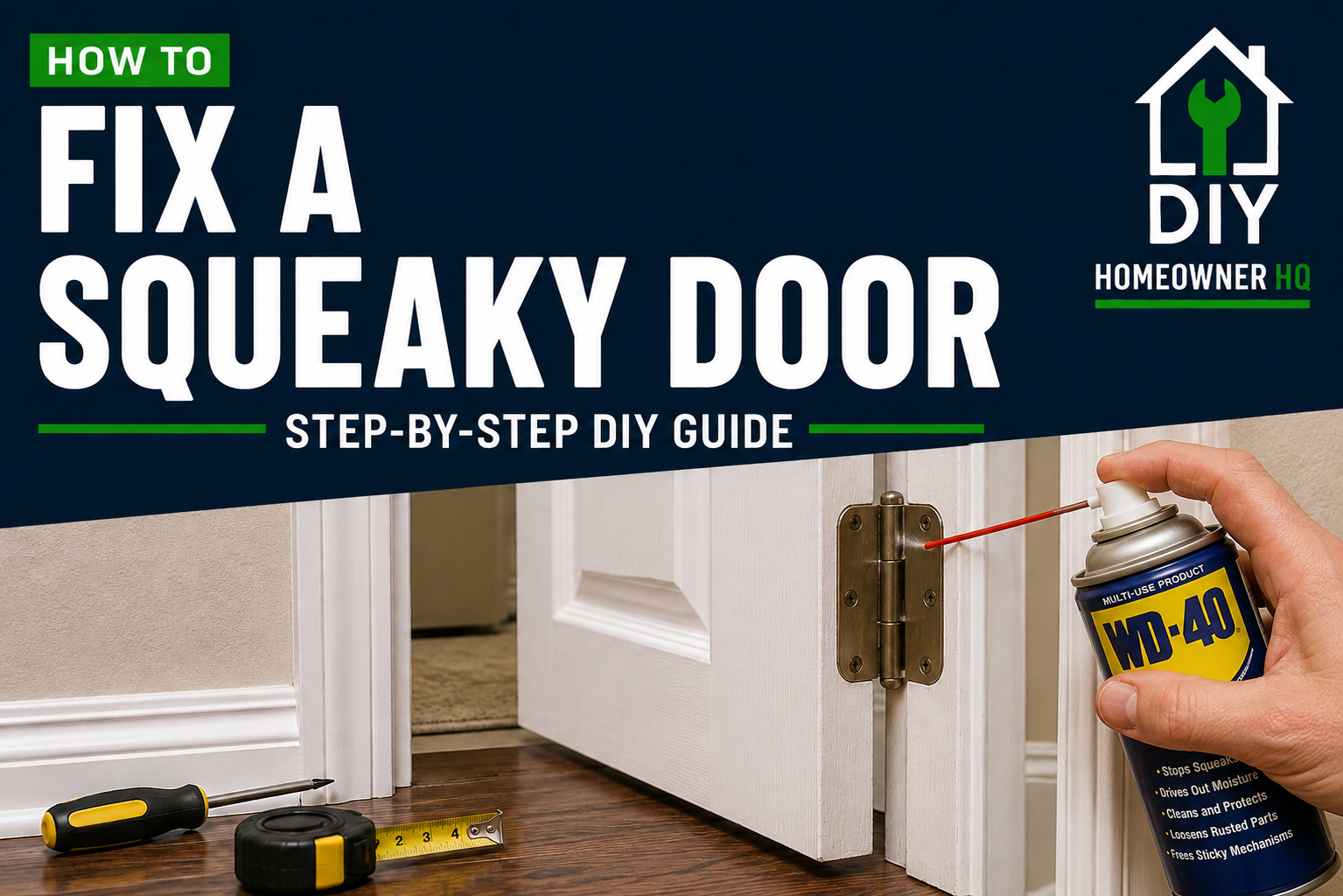
Apply a small amount of silicone spray, white lithium grease, or hinge lubricant along the hinge pin and where the hinge sections meet.
Open and close the door several times to work the lubricant into the hinge.
Avoid soaking the hinge. A little lubricant is usually enough, and excess will simply run down the door or trim.
What You Should See: The lubricant should work into the spaces between the hinge knuckles as you move the door.
💡 Pro Tip: WD-40 can help free up a dirty or rusty hinge and may stop the squeak temporarily, but a longer-lasting lubricant such as silicone spray or white lithium grease is usually a better choice for the final lubrication.
Step 3: Test the Door
Open and close the door several times.
If the squeak is gone, wipe away any excess lubricant around the hinge and you’re finished.
If you can still hear the squeak, listen again. Sometimes more than one hinge is making noise, especially on an older door.
Lubricate the remaining noisy hinge before taking anything apart.
What You Should See: The door should swing smoothly and quietly without lubricant dripping from the hinge.
Step 4: Remove the Hinge Pin if the Squeak Remains
If lubrication from the outside didn’t solve the problem, the hinge pin may need to be cleaned.
Close the door so its weight is supported by the frame.
Place a nail set, small screwdriver, or similar tool against the bottom of the hinge pin and gently tap upward with a hammer.
Once the pin rises enough to grab, pull it out from the top.
If necessary, use pliers to gently work it upward.
Do not remove all of the hinge pins at once. Work on one hinge at a time so the door remains supported.
What You Should See: The hinge pin should slide upward and eventually come completely out of the hinge.
If Yours Looks Different: Some hinges have non-removable pins or decorative caps. If the bottom of the hinge is enclosed and the pin will not move with light tapping, don’t keep hammering it. Lubricate the hinge externally or replace the hinge if necessary.
Step 5: Clean and Lubricate the Hinge Pin
Wipe the hinge pin thoroughly with a clean rag.
If you see rust, dried lubricant, or stubborn buildup, gently clean the pin with fine steel wool until the surface feels smooth.
Inspect the pin while it’s out. A severely bent, deeply rusted, or badly worn hinge pin may be better replaced.
Apply a thin coat of lubricant to the cleaned pin.
You don’t need to cover it heavily. A light, even coating is enough.
💡 Pro Tip: Before reinstalling the pin, wipe around the openings in the hinge knuckles. Old black residue inside this area can quickly contaminate a freshly cleaned pin.
Step 6: Reinstall the Hinge Pin
Line up the hinge knuckles and slide the pin back down through the hinge.
It may drop most of the way in by hand.
If it stops near the bottom, gently tap the top of the pin with a hammer until it is fully seated.
Wipe away any lubricant that squeezes out.
What You Should See: The hinge pin should sit completely inside the hinge with its head resting against the top hinge knuckle.
If Yours Looks Different: If the pin suddenly becomes difficult to reinstall, don’t force it with heavy hammer blows. Slightly move or lift the door to align the hinge knuckles, then try again.
Step 7: Open and Close the Door to Test It
Slowly open and close the door several times.
Listen to each hinge throughout the entire swing.
The door should move smoothly and quietly without squeaking, grinding, or binding.
Check the repaired hinge for excess lubricant and wipe away anything that works its way out.
If the same hinge continues squeaking after the pin has been cleaned and lubricated, inspect it for bent hinge leaves, excessive rust, or worn hinge knuckles. At that point, replacing the door hinge may be the better fix.
🛑 Common Mistakes to Avoid
- Using too much lubricant. Excess lubricant attracts dirt and can drip onto the door, trim, or floor.
- Removing every hinge pin at once. The remaining hinges help support and align the door while you work.
- Hammering aggressively on a stuck pin. Some hinges use non-removable pins, and excessive force can damage the hinge or trim.
- Ignoring loose hinge screws. Lubricant won’t correct movement caused by a loose hinge.
- Assuming every door noise is a dry hinge. A door rubbing against the frame can make creaking or scraping sounds that seem like a hinge problem.
- Reinstalling a dirty or rusty pin. If you already removed the pin, clean it before lubricating and reinstalling it.
❓ FAQs
What is the best lubricant for a squeaky door hinge?
Silicone spray and white lithium grease are both good options because they provide longer-lasting lubrication and stay in place better than very light penetrating products.
Can I use WD-40 on a squeaky door?
Yes, particularly if the hinge is dirty or beginning to rust. It can loosen buildup and quiet the hinge, but applying a longer-lasting hinge lubricant afterward can provide a more durable fix.
Do I have to remove the hinge pin?
Usually not. Start by lubricating the assembled hinge and working the door back and forth. Remove the pin only if the squeak remains.
Why does my door still squeak after I lubricated it?
The lubricant may not have reached the friction point, the hinge pin may be dirty or rusty, another hinge may actually be making the noise, or the hinge itself may be worn.
Should I replace a rusty door hinge?
Light surface rust can often be cleaned from the hinge pin. If the hinge is heavily corroded, bent, loose, or badly worn, replacement is usually the better long-term solution.
Why does the squeak keep coming back?
Repeated squeaking can mean the hinge needs a better lubricant, but it can also indicate worn hinge parts or a door that is putting unusual pressure on the hinge because it has sagged or shifted.
📞 When to Call a Professional
A squeaky interior door is usually an easy homeowner repair.
Consider calling a handyman or carpenter if:
- The door is extremely heavy
- Several hinges are pulling away from the frame
- The screw holes are badly stripped or damaged
- The door is sagging significantly
- The frame appears damaged or out of square
- The hinge is bent and the door no longer aligns properly
- The problem involves an exterior door that no longer closes or locks securely
If the door swings normally and the only problem is a squeak, this is typically a repair you can handle yourself.